
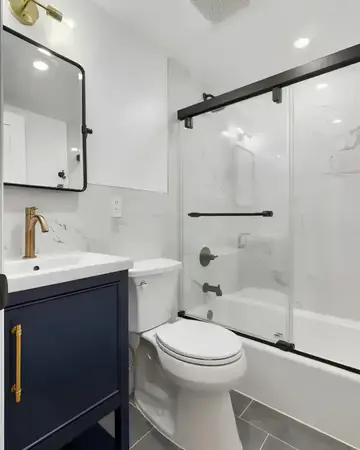
A bathroom renovation in Vancouver typically costs $12,000 to $22,000 for a basic refresh (new vanity, toilet, tile, fixtures and paint), $22,000 to $45,000 for a mid-range full renovation, and $65,000 to $85,000 or more for a luxury ensuite, according to HomeStars’ Vancouver cost guide, updated 21 August 2026.1
Those three bands are wide. HomeStars gives a standard five-by-eight main bathroom a mid-range figure of $18,000 to $35,000. Where your room lands depends on scope and finishes, and on the costs HomeStars prices separately: moving a drain, what demolition uncovers, and the tile you choose.
Every figure below comes from a published source, linked at the end. None of them is our price. Our price for your room comes as an itemised written quote.
What does a bathroom renovation cost in Vancouver in 2026?
HomeStars publishes Vancouver-specific ranges by scope and by room type, updated 21 August 2026:1
| Scope or room | What it usually includes | Published range |
|---|---|---|
| Basic refresh | New vanity, toilet, retile, fixtures, paint | $12,000 to $22,000 |
| Mid-range full renovation | Full gut, new tile, shower, vanity, toilet | $22,000 to $45,000 |
| Luxury ensuite | Heated floors, frameless glass shower, custom tile, premium fixtures | $65,000 to $85,000+ |
| Powder room | Refresh | $8,000 to $18,000 |
| Standard 5x8 main bathroom | Mid-range renovation | $18,000 to $35,000 |
| Master ensuite | Renovation | $35,000 to $65,000 |
| Condo bathroom | Standard renovation, no plumbing moved | $18,000 to $32,000 |
The size-based figure for a 5x8 main bathroom starts below the general mid-range band, and HomeStars itself describes a full gut as $18,000 to $45,000 in its introduction. A small room pulls the number down. If your budget sits near the bottom of a band, the useful question is which decisions keep it there. The rest of this article is those decisions.
Why does moving the toilet change the price so much?
Because it changes the job from replacing things to rebuilding a system. HomeStars puts relocating a toilet or shower drain at $3,000 to $6,000 or more on its own, and higher in a condo on a concrete slab, where the work involves slab drilling, strata approval, firestopping and waterproofing.1
It also changes the paperwork. The City of Vancouver says you need a plumbing permit “to install, change, or upgrade any part of a plumbing system,” and that you do not need one to “repair or replace fixtures (as long as they remain in the same location).”2 A new toilet in the old spot is a swap. The same toilet three feet over is new pipe, a permit and an inspection.
What this means for you: keeping the layout is one of the biggest levers you control, and HomeStars calls it “the single best way to control costs.”1 The first question to ask of any new layout is whether the plan actually needs the drain to move, or just needs better use of the wall it is already on.
What is behind the wall in an older Vancouver house?
Two things stay hidden until someone looks: water damage, which usually shows only once the tile comes off, and asbestos, which WorkSafeBC says you need to test for before a renovation or demolition project.
On hazardous materials, WorkSafeBC says that if you are a homeowner, you “need to get your home tested for asbestos before a renovation or demolition project.”3 It adds that if your home was built before 1990, “it’s likely that at least some parts of the home will contain asbestos,” and that newer homes can too if they were built with older materials.3 The testing is done by a licensed asbestos surveyor, and anyone you hire to deal with asbestos must be licensed to do that work in BC.3 Asbestos abatement employers have needed a licence since 1 January 2024, and WorkSafeBC publishes a registry of the ones that hold one.4
On contingency, HomeStars recommends 15 to 20 percent for pre-1980 Vancouver homes, to cover mould, asbestos or outdated plumbing discovered during demolition.1
Budget for an asbestos survey on any renovation that opens walls or floors, whether it appears on the contractor’s quote or you hire the surveyor yourself. On an older house, budget the contingency too. A quote that leaves both out, with no note saying why, is not cheaper. It has just moved the surprise to week two.
Where does the money go in a mid-range bathroom?
Labour is priced high here: HomeStars reports Vancouver labour running 20 to 40 percent above the national average, with plumbers at $100 to $200 an hour and tile installers at $12 to $25 per square foot for labour alone.1 Among materials, HomeStars names tile as usually the biggest variable, and also prices frameless glass and heated floors:1
| Item | Published figure |
|---|---|
| Tile labour | $12 to $25 per sq ft |
| Tile material | Ceramic $3 to $8 · porcelain $8 to $20 · large-format or stone $25 to $60+ per sq ft |
| Moving from budget ceramic to large-format or stone | Adds $5,000 to $15,000 |
| Frameless glass shower | Adds $3,000 to $8,000 over a prefabricated unit |
| Heated floor | Adds $1,500 to $4,000, depending on floor area |
| Relocating a toilet or shower drain | Adds $3,000 to $6,000+ |
| Toilet installation | $450 to $800 |
| Sink installation | $450 to $900 |
| Faucet installation | $250 to $500 |
Tile appears twice on a quote, once for material and once for labour, and HomeStars prices the move from budget ceramic to large-format or stone at $5,000 to $15,000. If you are choosing between two, our guide to choosing bathroom tile and flooring covers what each one asks of the installer.
Spend where you touch and see every day, and hold the line where you do not. A heated floor under a bath mat you stand on every morning earns its cost more easily than stone on a wall behind a door.
Is a condo bathroom cheaper than a house bathroom?
Usually not per square foot. HomeStars puts a standard condo bathroom at $18,000 to $32,000, and notes that condos typically cost more per square foot than houses because of strata approval, elevator bookings, protection requirements, and drilling through concrete to move a drain.1
In a condo, read your strata bylaws and get approval in writing before any demolition date is set. The schedule is often decided by the building, not the contractor.
Do I need a permit for a bathroom renovation in Vancouver?
Yes, if anything is moved or new wiring or plumbing goes in. No, if you are only replacing fixtures, cabinets or flooring in place. The City requires a plumbing permit to install, change or upgrade any part of a plumbing system, and exempts fixtures only when they are replaced in the same location.2 Moving a toilet changes the system. For a tub-to-shower conversion, confirm with the City before it is priced. The City also lists renovations that move interior walls or existing plumbing, electrical or gas lines among the work that generally needs a permit, along with drywall repairs to fire separations in multi-unit residential buildings, which can apply in a condo.5 Vancouver issues its own electrical permits, and almost all electrical work needs one, a heated floor included; the exceptions are like-for-like replacements of fuses, receptacles, switches and bulbs. Replacing plumbing fixtures in place, cabinets or flooring does not need a permit.5
The City’s 2026 fee schedule charges $282 for a plumbing permit covering one to three fixtures, plus $88.70 for each additional fixture. A building permit, if walls or structure change, is charged separately.6 HomeStars estimates about $900 to $1,300 in total permit fees for a typical mid-range bathroom that needs permits, without breaking that figure down.1
Skipping the permit is the expensive option. The City says a “work without permit” penalty is typically double the original permit fee, that work must stop while the application is processed, and that, as the homeowner, “you are responsible for paying these fees or penalties yourself even if you have hired a contractor who assured you that permits were not needed.”5
What this means for you: ask who pulls each permit before you sign, and get the answer in the contract. We walk through the rest, municipality by municipality, in what actually needs a permit in Vancouver.
Are renovation costs in Vancouver still going up?
Not much, on Statistics Canada’s building construction price index. Residential construction costs in Vancouver fell 0.2 percent in the second quarter of 2026, one of only three cities in the index to decline, and were about 0.5 percent higher than a year earlier. Across the 15 cities in the index, residential costs rose 0.5 percent in the quarter and 2.3 percent over the year. Nationally, the release, on 24 July 2026, named metal and steel products as the leading source of increases.7
That index tracks the cost of building new residential structures, not renovations, so read it as a signal about materials and labour rather than a price for your bathroom.7 If two quotes for the same bathroom are far apart this year, the gap is more likely scope, allowances or exclusions than a jump in what materials cost.
How long does a bathroom renovation take?
HomeStars gives one to two weeks for a basic refresh, two to four weeks for a standard full renovation once materials are on site, and five to six weeks for larger ensuites with custom tile or structural changes.1 Material lead times and what demolition uncovers are the usual causes of delay.1 HomeStars’ two-to-four-week figure for a standard renovation starts once materials are on site. Permits, strata approval and any asbestos survey or abatement come before that.
Order long-lead items, like a custom vanity, before demolition starts. Custom shower glass is measured once the tile is installed, so book the measure ahead for that day and ask the glass company how long fabrication takes. Every day the measure waits is another day without a working shower.
What should a bathroom renovation quote show?
Every line you would otherwise have to guess at. A quote you can compare against another one names the scope item by item and separates labour from materials. It states allowances as dollar figures, lists exclusions in writing, and shows the permit, the contingency and, unless you are hiring the surveyor yourself, the hazardous materials survey as their own lines.
If one quote is much lower than the others, look first at what it leaves out. A common gap is an allowance set too low for the finishes you actually want, which turns into a change order when the real finishes are chosen.
What this means for you: before comparing prices, make the quotes comparable. Then compare the people, starting with the checks in how to check a BC contractor’s licence and insurance.
Common questions
How much does a small bathroom renovation cost in Vancouver?+
HomeStars’ 2026 Vancouver guide puts a powder room refresh at $8,000 to $18,000 and a mid-range renovation of a standard 5x8 main bathroom at $18,000 to $35,000. Keeping the toilet, tub and sink where they are avoids the $3,000 to $6,000 or more that HomeStars puts on moving a drain, and HomeStars calls it the single best way to control costs.
How much does it cost to move a toilet in a Vancouver bathroom renovation?+
HomeStars puts relocating a toilet or shower drain in Vancouver at $3,000 to $6,000 or more, and higher in a condo on a concrete slab. Moving a fixture also needs a City of Vancouver plumbing permit, because the City only exempts fixtures that are replaced in the same location. The City’s 2026 plumbing fee is $282 for one to three fixtures, plus $88.70 for each additional fixture.
Do I need an asbestos test before renovating a bathroom in BC?+
Yes. WorkSafeBC says homeowners need to get the home tested for asbestos before a renovation or demolition project, using a licensed asbestos surveyor. It adds that a home built before 1990 is likely to contain asbestos in at least some parts, and that newer homes can too if older materials were used. Anyone hired to deal with asbestos must be licensed to do that work in BC.
How much contingency should I budget for a bathroom renovation?+
HomeStars recommends a 15 to 20 percent contingency for pre-1980 Vancouver homes, to cover mould, asbestos or outdated plumbing discovered during demolition. Newer homes can reasonably carry less, but the contingency should appear as its own line on the quote either way.
Is it cheaper to renovate a bathroom in stages?+
It lowers the upfront cost but usually raises the total. HomeStars notes that contractors charge to remobilise each time they return and trades bill a minimum call-out per visit. Work that disturbs the same surfaces, such as tile and the plumbing behind it, is cheaper done once.
Get an itemised quote for your room
Book a no-obligation consultation, and we will follow up with an itemised written quote.
Sources
Every figure and quotation above comes from the source named. All sources accessed 10 September 2026.
- HomeStars — 2026 Bathroom Renovation Cost Guide for Vancouver, updated 21 August 2026.
- City of Vancouver — Get a plumbing permit.
- WorkSafeBC — A home renovation shouldn’t actually take your breath away.
- WorkSafeBC — Licensing and certification for asbestos abatement: new requirements (effective 1 January 2024).
- City of Vancouver — When you need a permit; Electrical permit.
- City of Vancouver — 2026 Schedule of Fees for Development and Building Related Permits, Part B, Plumbing Permits (effective 1 January 2026).
- Statistics Canada — Building construction price indexes, second quarter 2026, The Daily, 24 July 2026; Table 18-10-0289-01.
Related reading
- How Much Does a Home Renovation Cost in Vancouver?
- Renovation Permits in Vancouver: What Actually Needs One
- How to Choose Bathroom Tile and Flooring
- Bathroom renovations in Vancouver
Naybur Contracting · 2184 W Broadway #615, Vancouver, BC V6K 2H7 · 236-516-3566 · Serving Vancouver, North Vancouver, West Vancouver, Burnaby, Richmond, Surrey, Coquitlam, Delta and Langley.